Garage Floor Epoxy in Spokane Valley, WA
Washington lets drivers run studded tires from November through March, and a good share of Spokane Valley takes the state up on it. Those studs come home covered in gravel and deicer, park on your slab, and sit there dripping for eight hours. That is the actual load a garage floor here has to survive — not spilled oil, not a dropped wrench. This page is about specifying a coating that handles it, and about the four ways the cheap ones fail.
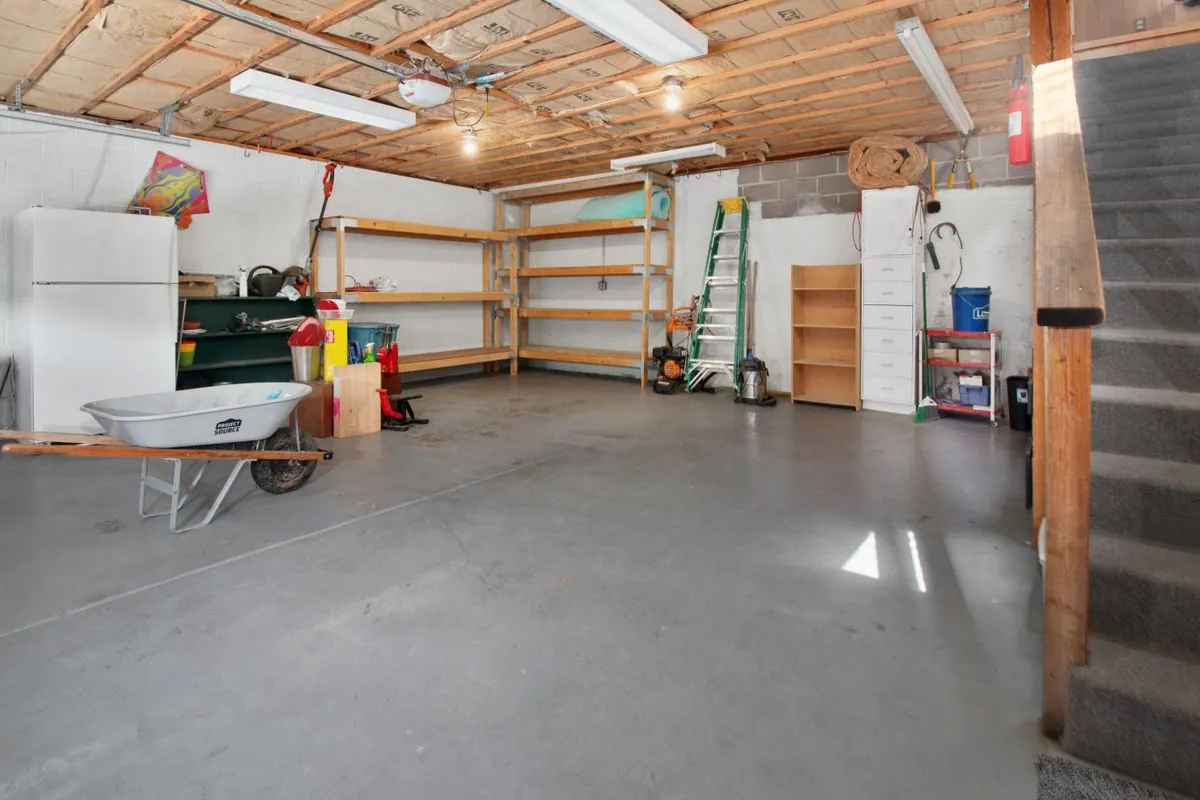
What Winter Actually Does to Bare Garage Concrete
Three separate attacks run at the same time from November onward, and they compound.
The first is abrasion. Studs and the grit thrown down on Sprague and Trent get carried in on tread and ground into the slab surface every time the wheel turns while parking. Uncoated concrete is soft enough that this polishes and then powders the top layer.
The second is chemistry. Washington leans on magnesium chloride and sand more than rock salt, and magnesium chloride is arguably harder on concrete than sodium chloride is — it attacks the cement paste directly and keeps water liquid at lower temperatures, so the slab stays wet longer.
The third is the freeze-thaw cycle. Spokane Valley swings across freezing repeatedly through the winter, and any moisture that soaked into the pores expands each time it turns. That is what pops the surface off in flakes around the parking spots.
A bonded coating stops all three at once, because none of it reaches the concrete anymore. Meltwater sits on top until you squeegee it out the door.
The Four Ways a Garage Coating Fails
Every failed floor we grind off traces back to one of these, and all four are avoidable.
Prep that was not real. Acid etching is the usual culprit. It leaves residue, profiles unevenly, and gives the resin nothing mechanical to key into. Diamond grinding or shot blasting are the only two acceptable answers, and a bid that does not name one of them is quietly cheaper for a reason.
Moisture nobody measured. Vapor pushing up through a slab collects under a film that cannot breathe and lifts it in sheets. A written calcium chloride or in-slab humidity reading takes an afternoon and costs almost nothing. Mitigation primer, if the number comes back high, runs $1.00 to $1.75 per square foot.
Curing too cold. Resin chemistry slows and then stalls as the slab drops toward the forties. The floor feels dry, never hardens fully, and marks under a hot tire the next summer.
Not enough material. A thin build can be sprayed on in a couple of hours and looks perfect at handover. It wears through at the tire tracks first, usually inside two winters.
Specifying the Floor for What You Actually Park on It
A commuter sedan and a three-quarter-ton diesel are not the same load, and the quote should not be either.
For a daily driver in a two-car garage, a standard flake build with a polyaspartic clear is plenty. For a heavy truck, a boat trailer on a jack, or anything with a floor jack rolling under it, we go thicker and add a second clear coat, because point loading from a jack stand is what dents an under-built floor.
If you weld or run a grinder in there, tell us up front. Hot slag will scar any resin floor, and the sensible fix is a sacrificial mat in the work zone rather than a different coating.
Traction matters more here than in a mild climate. Cars come in wet or snow-covered for months, and a glossy floor with meltwater on it is genuinely slippery. Fine polymer grit blended into the clear solves it for almost nothing, and we include it on every garage unless you ask us not to.
What It Costs, Line by Line
A standard two-car garage in Spokane Valley generally runs $1,700 to $3,200 coated. The variables:
Slab condition. Spalling, deep pitting, or a previous coating that must come off adds $1.50 to $3.50 per square foot before new material goes down.
System build. Solid color is the baseline. Full flake broadcast adds roughly $0.50 to $1.00 per square foot. Adding a second clear for a heavy vehicle adds a bit more.
Moisture mitigation. $1.00 to $1.75 per square foot, only if the test calls for it.
Size. Single-car bays start around $1,000 to $1,600. Three-car and oversized shop garages run $2,800 to $4,800.
Season. A deep-winter install may need heaters staged in the space and a cold-cure product, both of which cost more than the same job in June.
Quotes are written and itemized, with the moisture number and the mil thickness printed on them. Those two lines are how you compare us against anyone else.
Flake, Solid Color, or Metallic
Flake is what most Spokane Valley garages should buy. The chip pattern camouflages the grit and salt residue that will be on the floor from December to March, the texture adds grip, and a damaged area can be patched without the repair shouting.
Solid color is the cleanest look and the cheapest. It also shows every speck of dirt and every tire mark, which in a winter climate means it looks its best about four months a year.
Metallic belongs in a garage that functions as a display or hangout space rather than a working one. It is the most striking and the least repairable of the three.
Our honest recommendation for a garage that stores actual vehicles through an actual Spokane winter is flake, every time, and put the money you saved into a second clear coat instead of a fancier pattern.
Frequently Asked Questions
Will studded tires tear up an epoxy garage floor?
Not if the build is thick enough. Studs only contact the floor at low speed while parking, so the risk is scuffing rather than gouging. We spec a polyaspartic wear layer and 20 mils or more of total build on any garage that runs studs between November and March, and those floors come through the season fine.
My slab already has cracks. Is it too late to coat it?
Cracks are normal and not a disqualifier. Static cracks get opened into a V, filled with a rigid filler, and disappear under the coating. A crack that is still moving gets a flexible filler and will likely reappear as a faint line, which we tell you before you pay rather than after.
How thick should a residential garage coating be?
Ask for total dry film thickness in mils and expect 20 to 30 for a real system. Thin sprayed builds under 10 mils look identical on handover day and wear through at the tire tracks within a couple of winters. Thickness is the number that separates two bids more than brand does.
Can you coat a garage that is not heated?
Yes, but the material has to change with the season. Standard epoxy needs the slab near 55°F to harden fully, so from late fall through early spring we switch to a polyurea or polyaspartic build that cures cold. Anyone quoting straight epoxy for a January install in Spokane Valley is setting up a failure.
Looking at other spaces? See basement floor epoxy in Spokane Valley, or polished concrete if you would rather have no coating to maintain.